
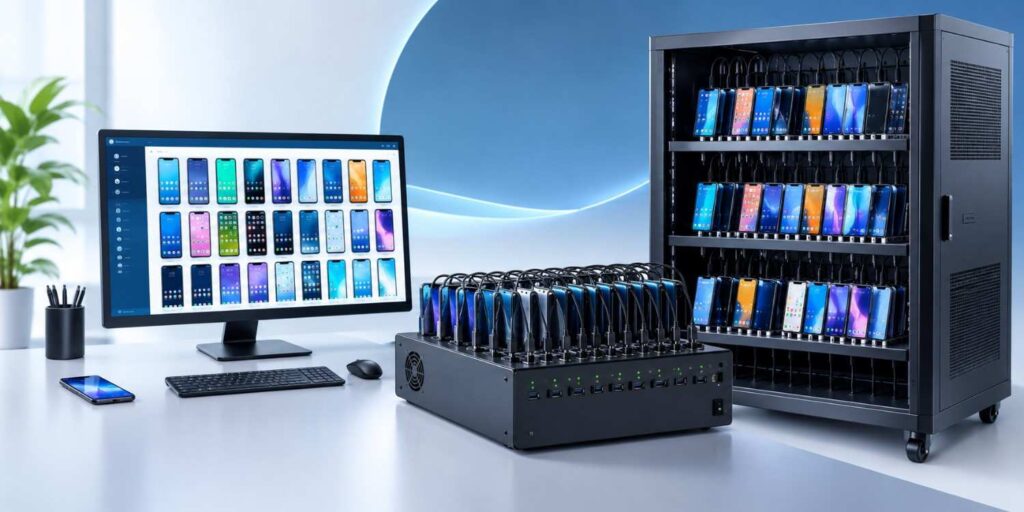
A phone farm is a hardware and software infrastructure designed to arrange, supply, and control multiple smartphones in a centralized environment. Phone farms can be employed for proper testing of mobile applications, checking compatibility, conducting automated quality assurance, and controlling applications on different Android-based devices.
What Is a Phone Farming Machine?
Phone farming machines are dedicated platforms where multiple smartphones or boards of mobile devices are arranged in some order. In terms of their construction, depending on the design of such systems, there can be included USB connectivity, power supplies, cooling mechanisms, brackets for mounting devices, and remote device management.
Compared to several phones that are separately managed, centralized platforms allow easily monitoring connected devices, installing test applications, gathering diagnostic logs, and performing repeated testing procedures. All this is dependent on the number of devices, required power supply, and software.
Box Phone Farm Characteristics
A box phone farm refers to a device or a rack capable of holding a number of phones or any mobile hardware. It is designed for holding the devices organized and allowing them to get connected to a power source and/or data.
- When examining a phone farm based on the box technology, one should consider the following aspects:
- Number of devices that the device can hold and which can be easily reached.
- The total power output that is provided by the power source and enough for all connected devices.
- Availability of cooling and ventilation to maintain the adequate temperature.
- Availability of USB data connection and compatibility of cables used and access to individual devices.
Easy replacement of damaged cables, devices, and other elements.
Purpose of Phone Farm Box
Phone farm boxes can be used for various professional tasks in combination with the right device management software.
Mobile app testing: Applications can be tested with respect to the Android version, screen size, and hardware components.
Quality assurance: Testers will be able to compare application performance and reproduce errors.
Automated testing: The use of compatible tools will allow testers to run a series of pre-configured tests to check the application performance.
Monitoring devices: Device management will facilitate the process of checking the status of devices, receiving logs, and managing software updates.
Research and development: The use of multiple devices can help hardware teams to study device connectivity, application compatibility, and other mobile computing behaviors.
The usage of actual physical devices is important for those cases when certain features behave differently on the actual devices compared to the emulator environment.
Phone Box Farm vs. Traditional Device Testing
A phone box farm provides a physical environment for operating multiple devices, while traditional testing may rely on individual phones, virtual devices, or cloud-based device laboratories.
| Feature | Phone Farm Setup | Virtual Testing |
| Physical hardware | Uses real devices | Simulates devices |
| Hardware-specific testing | Supports real hardware behavior | May not reproduce every hardware condition |
| Initial setup | Requires devices and infrastructure | Often requires less physical equipment |
| Maintenance | Includes hardware and cable management | Primarily software and platform management |
| Scalability | Depends on space, power, and budget | Depends on computing resources and service limits |
The most suitable approach depends on the testing objectives. Many teams combine physical devices with virtual testing to cover a broader range of scenarios.
How to Pick the Right Phone Farm System
Prior to buying a phone farm, define what kind of workload it is going to handle. Determine the capacity of devices, the speed of USB, power usage, network conditions, and software.
For the purpose of testing the Android applications, check if the management software can handle the particular version of Android and particular devices. It also matters to make sure that single device control, remote management, tests automatization and diagnostics are possible.
Do not forget about electrical safety, quality of cables, ventilation and the size of enclosure. Modular system might be easier to scale than rigid one.
Conclusion
The right phone farm system will serve as a basis for your work with multiple phones, testing, application development and administration. No matter what you are choosing – a phone farming machine, a box phone farm, or a phone farm box, do not forget about the actual technical needs and requirements.